

Like pieces of a puzzle, all ethnic groups of America fit together to form the picture the world knows today: diverse, inclusive, and powerful. In May, we celebrate Asian American and Pacific Islander Heritage Month (AAPI Heritage Month) to highlight the accomplishments, history, and impact of Asian Americans across time.
Within the North Penn School District, one of the most diverse districts in the Philadelphia area, Asian Americans make up 20.7% of the student population, but up until this year, there has been no representation on the school board. In the 2025 election, however, that all changed.
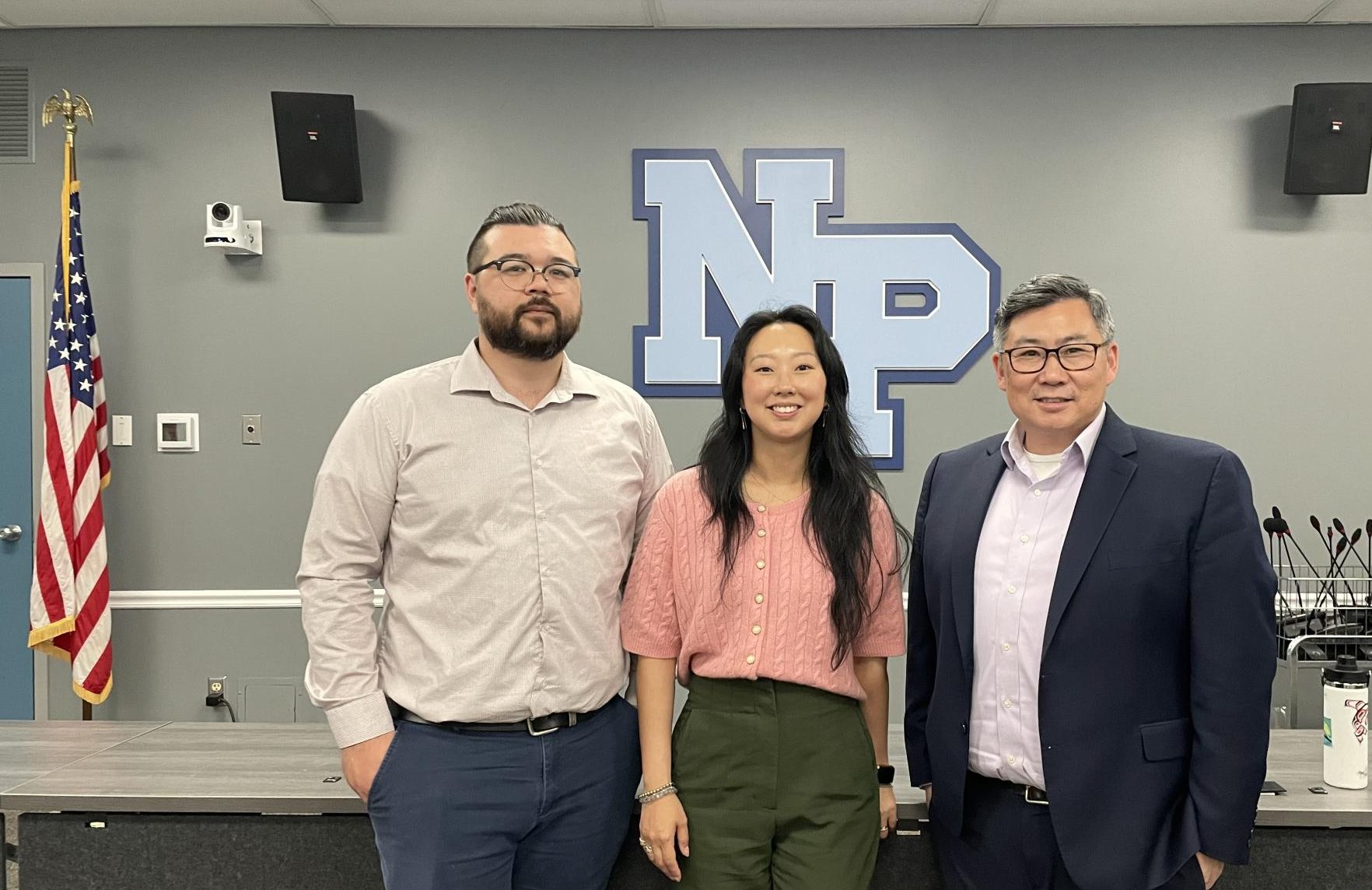
Mr. Koh Chiba and Mrs. Christine Coyne were elected to the school board in November of this school year. They marked the first Asian American school board members in history. One month later, Dr. Mark Teoh joined them, totaling the addition of three Asian American board members in a single year.
Now, having six months to settle into their positions on the board, we were curious to hear about their experiences so far and the influence of Asian American culture on their lives. As Asian American students within the North Penn School District ourselves, this topic sits very close to home. Sitting comfortably around a table, the atmosphere casual and light, we began the interview: a chance to officially meet the school board, refreshed with a new perspective.
Alex Kim: With Asian American and Pacific Islander Month [this] month, and with you three as the first Asian Americans on the school board, what does being Asian American mean to you?
Mr. Koh Chiba: (pause) I don’t dwell on [my heritage] particularly much, but […] I’m very proud of my heritage. I’m half [Asian]; my dad’s Japanese and my mom’s Scottish-Polish. I’m very proud of my background, but I feel like I’m very fortunate that I don’t have to think about it all the time.
Emilia Adarayan: Did each of you grow up with a lot of Asian culture influencing how you grew up?
Mrs. Christine Coyne: No. I’m adopted by a South Philly mother and an East Falls Protestant father. I’m a transracial adoptee in a Caucasian family, so anything that I’ve learned or tried to absorb about Asian American culture has been a conscious effort as an adult or as an older adolescent, and finding that interest. [As] you said, we’re the first Asian Americans elected to the North Penn school board [and, a lot of the times] there’s a lot of (pause) I’m going to say (pause) imposter syndrome, for me personally, because I was raised in a very white household. There’s an issue of me wanting to feel Asian enough, and a good representative … because I’m burdened with wanting to pay things back for the rest of my life. I want to do a good job at it, so I want to make sure that the work that I do, whether I’m Asian American or not, is good work and something that I’d be proud of [and] that my kids would be proud of.
Alex Kim: Did you grow up with any Asian influence [or role models]?
*Note from the writers: They all laughed. Who is Connie Chung?
Dr. Mark Teoh: When I was growing up in New York, I had maybe one Asian American educator. I didn’t really think about that a whole lot until much later in life. When I was a first or second year teacher, I taught high school history [and] I had a young man in one of my 10th grade classes; let’s call him Jay for this particular story. Jay was of Vietnamese-Chinese background. I think he was either a recent immigrant or his parents had immigrated from Vietnam, and he said to me, “Mr. Teoh, you’re one of the first teachers I’ve ever had who looks like me.” […] And so when he had some challenging times later in his high school career, he reached out to me, and we talked, and I have to believe [that] some part of that relationship building might have had to do with our shared background. […] I always think: What does it mean for others around us, who sees us in terms of our identities? As Ms. Coyne mentioned, what is the impact for others when they see that kind of example or representation? […] Recently, Mr. Chiba and I went to visit Montgomery Elementary for the Lunar New Year celebration, and we got to see the entire elementary school learn about this cultural thing that wasn’t available to me growing up 40 years ago. And so, to see that in North Penn School District is incredibly powerful, but it’s not just that [example] of representation; we see that focus on inclusion and belonging across all of our schools and across a lot of cultural identities, which is something that I’m incredibly supportive of.
Mrs. Christine Coyne: I think [with] Diwali being recognized, there’s a lot of Asian American holidays and diverse holidays, whether cultural based or religious based, that are much more inclusive now within the district, and it’s much better at representing the population of students that they’re celebrating. […] As kids growing up, it didn’t happen like this, so it’s wonderful to see. I think there’s work to be done to continue it, but the contrast between growing up when we did versus now… you would never have told me in a million years what is involved in the media and available in pop culture and celebrated now, [like] K pop and different dramas […] I would never have dreamed that as a little girl; I would never have thought that that would be possible and embraced.
Mr. Koh Chiba: It’s funny. I never really thought about it, [but] I’ve never had an Asian teacher.
Mrs. Christine Coyne: (enthusiastically) Yeah, me neither!
Alex Kim: Actually, I don’t think I’ve had any either.
*Note from the writers: How was this just occurring to us now?
Alex Kim: Having Asian American teachers is also really important. A lot of Asian American kids, or minority kids in general, who have unique sounding names, are always used to their names always being mispronounced in class […] It doesn’t mean much in the grand scheme of things […].
Mr. Koh Chiba: It means a good amount, I think. […] I feel like most of those things are small things. It’s not one of those big, huge moments of “I feel seen.” It’s the small things where like, “Oh, I can relate,” or “I don’t have to explain this thing because we both know the background.”
Mrs. Christine Coyne: Can I counter and say that I think it’s a large thing? I think it actually is a large thing. I think there’s a lot of which we just deal with, in particular, in the Asian American community, whether it be microaggressions or not. And I think some of the things, like a name pronunciation, that’s a big thing for someone [to get it right] or to make the effort to pronounce your name correctly.
Emilia Adarayan: Mr. Chiba, I had a question sort of directed towards you: so, speaking of identity […] for me, I’m also half Asian, half Caucasian, and a big thing in my life was whenever we would fill out forms saying, “What is your race” if it made me choose one, I wouldn’t be able to choose, so I would say “Other,” […] did that ever affect you in your youth?
Mr. Koh Chiba: I mean, definitely on the form, I always picked Asian. I think sometimes, again, it’s that lens thing; […] anyone that’s not Asian thinks I’m 100% Asian [but] 100% Asians think I’m white.
Mrs. Christine Coyne: We all have mixed race children.
Mr. Koh Chiba: Mine are very…there’s a lot of cream color in there. There’s only a quarter [of Asian] left there [in my children], so they’re being diluted! But no, so I guess to that answer, I definitely feel I’ve had to think about that, you know, when I fill out [the form], am I being genuine when I say that [I am Asian] or am I taking advantage of it? But then also, if everybody, especially people in power, looks at me, all they see is the Asian side of me. I’m not embarrassed. I’m proud of the Asian side of me, so I’m happy to lean toward it, but I also do make a point to say that I’m half. I’m more than this one side of the culture. I’m proud of my Scottish Polish background, but also I don’t want to feel as though Asians [see me as] not pure blood. (laughs) The only Asian influence I ever had growing up, going back to an earlier question, was basically just my dad. And he, at the same time, was struggling with, because he immigrated here when he was in his early 20s, how to become more American. And I think it made it complicated for him to also instill his culture in me because he was trying to learn American culture. So it’s kind of a complicated thing.
Dr. Mark Teoh: When my 4th grader had to register during kindergarten […] I remember getting to the checkboxes, and they were where you can only choose one or other. I actually chose not to respond to that question because of the fact that it was so mutually exclusive and I think that’s not how our society works these days. I thought, if I ever get a chance to talk to the superintendent, maybe we could talk about this one day, and I just realized that I forgot. It’s on my to-do list.
Mrs. Christine Coyne: I think it’s so crazy because I just registered my third kid for kindergarten and I just did Asian, […] but I had the same thought.
Alex Kim: Is there anything that comes to mind for you three that, off the top of your head, you want to change to make inclusivity for Asian Americans better in the district?
Mrs. Christine Coyne: So, I want to put this forward first with what we want to see. I think once elected to the school board, I [found] that I have to put aside whatever I want personally in favor of what the community is asking for. So, I guess I just want to make that distinction that [this school board position] truly is an elected public servant role. […] That being said, what I’ve heard is, the inclusion of Asian American history and culture in the curriculum… [That is] something that the community would have to advocate for, and we would be open to listening and making decisions based on the feedback that we get.
Dr. Mark Teoh: That’s interesting. I don’t know if there’s a specific Asian American issue that I’m driving on. I think my own heritage or ethnicity has shaped how I think about being “other,” […] but all of that was just part of what I feel like I’m bringing to this particular role as an educator, as a resident and community member. It shapes how I approach the work, but I think the thing that I would draw on my own background is how do we ensure that our school system meets the needs of all young people in our community? Particularly those that may not have a voice in certain spaces, particularly spaces of power and influence. And so, regardless of background and their heritage, what are we doing to ensure that level of belonging and inclusivity across our incredibly diverse North Penn community?
Alex Kim: How important do you think seeing Asian American history represented, especially in the history of America, is for students?
Dr. Mark Teoh: I think our American history has to reflect all of our different cultures, and all the contributors who made our country what it is today: Asian American, African American, Latino backgrounds. These are all aspects of the American culture and background that we need to work on to create opportunities for that learning and access to occur across our school system.
Mrs. Christine Coyne: Yeah. And not just a [specialized] course, but embedded, right? Every single culture. And I was saying, I was whispering to Koh, even Native Americans as well. It all creates what the fabric of our country is, and it’s all the diverse perspectives.
Alex Kim: I feel like in all my American history classes, we’ve kind of just glazed over [Asian influence in America] with the railroad building, and then the camps […it’s] never really indefinitely talked about. So, I was just curious if you guys haven’t even had any opinions about that.
Mr. Koh Chiba: So kind of funny, you mentioned that. […] Those [topics] you just mentioned were the only two things that I can really think of that I ever went over in history class, and [there’s] so many more contributions that the Asian American community has made. […] I would love for us to not gloss over the terrible things that happened or [when] people were taken advantage of, but also [focus on] the positive contributions, which I think is a really important difference there.
Mrs. Christine Coyne: They exist, but they weren’t taught to me. So how do I know to advocate for them if they weren’t taught to me?
Mr. Koh Chiba: I didn’t learn this in school, but the first woman of color in Congress was Patsy Takemoto, and she was the main author for Title IX. That’s something that affects, especially students, on an everyday basis. I didn’t know about her until recently. It’s something that we should be learning. […] It’s important that people feel as though they see themselves in their mentors or their leaders. I think that we also have not just in North Penn, but in the US, a way to go in terms of making that progress. […] In North Penn, I think about 20% of students identify as Asian, and I don’t know if that is equally reflected in our faculty. It doesn’t have to be a one for one, but I think, in an ideal world [it would be close].
Alex Kim: I can think of only two [Asian] teachers off the top of my head.
Emilia Adarayan: I can name one!
Mr. Koh Chiba: This isn’t just for Asian Americans, this is in general, I think that goal will always be that the people in charge and the people that are mentors and examples look like the people that they educate. And it doesn’t have to be exact, but that should be the goal. I’m not talking about implementing the Rooney rule in interviews and things like that. It has to go farther than that.
Alex Kim: I think all my teachers are white actually.
Emilia Adarayan: Were you just thinking about that the whole time?
Alex Kim: Not the whole time…
Emilia Adarayan: (to the interviewees) Did the influence, or I guess, the lack of influence of Asian heritage on the school board affect your decision to run for school board? Or was it not really a thought in your mind when you decided to run?
Mr. Koh Chiba: Interestingly, part of the reason I was reached out to was because existing members of the board recognized that there was an absence [in Asian American representation].
Emilia Adarayan: You were reached out to?
Mr. Koh Chiba: I was the campaign manager for the 2023 election, but I’d also interviewed to be part of that slate. And at that point, there was only one spot open and I had interviewed for that as part of endorsement products. [The school board] went with Kunbi [Rudnick], very, very warranted and deserving of the endorsement, but I know that part of the conversation was that, with such a large Asian American population, they recognized that there was a lack of [representation] on the board. So, I don’t know if I applied because I saw that gap there. I think I applied because I feel strongly about education representation, but I think I also knew, going into it, that there was an additional layer of responsibility in that role, because we were overdue representation for that. […] I went in fully knowing that this was something that was gonna be important to me as I ran.
Dr. Mark Teoh: And so, if you recall, I joined the board after Miss Coyne and Mr. Chiba were already elected. So, explicitly, that was not part of my decision to apply for the vacant position. It’s hard to differentiate. [My culture is] part of my experience, same as being a high school history teacher or district administrator; it’s all of what I bring to a particular role. The identity issue is not the thing that was my most pressing or priority thing. Rather, it is just to bring and leverage my understanding of education systems to the role.
Mrs. Christine Coyne: And I think that’s interesting because I have felt that being a woman, being a person of color, [and] being an Asian American, I have found myself fighting against the concept of others saying I was a diversity hire [or] I got that [position] because I checked a box [as] an Asian woman. […] I have fought my whole life and overcompensated. Like “I’m gonna be so good, I’m gonna be everything, I’m gonna do everything, I’m gonna read everything. I’m gonna be so good that no one can say that about me. I’m gonna completely overcompensate to make sure no one can say that I just got it just because of my ethnicity or my gender.” (said with humor) But cheers to everyone that can reap the benefits of me trying to overcompensate.
Mr. Koh Chiba: What was really nice too was that we didn’t have to do it alone. A lot of times, when that threshold is broken, when it’s the first person of color or the first woman, it’s just one person alone, and they have to carry that torch or that responsibility by themself. It’s nice going in with, initially two then three. I don’t feel as though that it’s on me alone to always bring up that issue. It’s nice. It’s a luxury that not everyone that breaks that ice gets.
Mr. Koh Chiba: It’s nice being able to have this conversation. I feel like we probably have more common experiences between us and you in this conversation than I have in most of my conversations. And also I don’t usually spend that much time talking about Asian culture in general, especially outside of next month. But it’s kind of nice. This conversation feels like something that I don’t get to have often.
Mrs. Christine Coyne: You made us feel very safe to talk to you.
Alex Kim: That was our goal.
Dr. Mark Teoh: And then I do hope that it is an opportunity for you and your classmates to really think about if there are voices that are not being heard. […] I’ve been really impressed with how my colleagues on the board are deeply interested in ensuring that voices from the community are understood and included in our conversations and discussions, and in the direction of the district. But certainly, there’s an invitation to you and your classmates, if there are times when certain communities don’t feel well represented, or they feel like their voice is not being heard, it’s an invitation to reach out to the school board to engage in those discussions because we are deeply interested in hearing from all aspects of North Penn.
Mr. Koh Chiba: In the Asian American global look, we’re all East Asian. And, for AAPI, the reason there are so many letters is because there’s so much diversity within Asian culture, we have a very large Southeast Asian community that doesn’t have representation on the board, and it doesn’t mean that I don’t feel the responsibility of representing that community as well, but also that community would love to see [representation of their own]. […] Their experience is very different than mine, even though we’re both Asians, and so I want to make sure that that community is brought into the fold.
By the end of the interview, it became clear that this interview was larger than an article about the school board. The hour and a half we had planned on asking about their Asian American heritage influencing school board policies turned into an in depth discussion where everyone present could make new connections and relate to the same experiences. Whether it be similar household circumstances or cultural confusion, each individual brought fresh perspectives to the table that were eye opening to the rest and helped to alleviate those feelings of isolation.
With the recent developments of Asian perspective within the North Penn schoolboard, achievements of equality have become increasingly more achievable. By spreading the message of inclusivity, all three new members are paving pathways for Asian American influence that not only affect the North Penn community, but also spread awareness and expectations for larger society.