

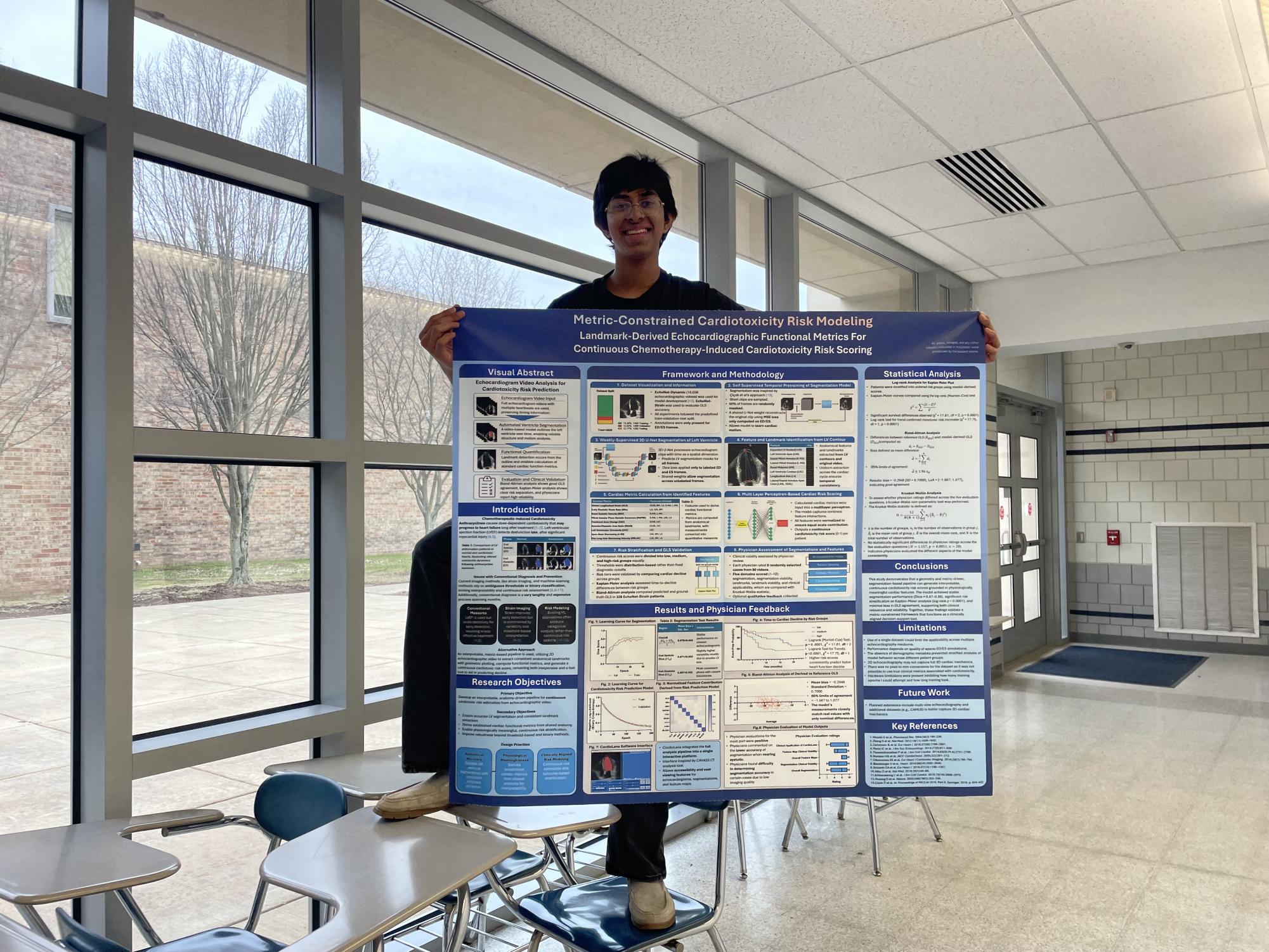
“When people think ‘science fair’, they think baking soda and vinegar volcanoes,” Junior Pramith Pradeep explained, “but that’s not what this is.”
The Montgomery County Science Research Center (MCSRC) Competition is happening on March 26th at Germantown Academy. For students all over the county, this is their opportunity to show off their scientific interests in a professional setting with expert input. The top five winners from this fair (the top three from grades 9-12 and the top two from grades 6-8) will move on to the regional Delaware Valley Science Fair, which is much more competitive than the county fair, with the number of participants ranging from 900 to 1,000.
Most students have done a science fair project in elementary school, or even in middle school. Many can recall their gymnasiums full of trifolds depicting petri dishes, baking soda and vinegar volcanoes, and jumping beans in plastic bottles. This group of students participating in the MCSRC do much more than that.
“There are many people with breast cancer, pancreatic cancer, [etc.] and one of the most common types of treatment is using a drug known as anthracycline. These drugs are very high risk, high reward. They’re very effective at eliminating cancer, but they can lead to long term cardiac diseases. What my project aims to do is find an alternative method to detect these heart diseases early because current methods only detect it in late stages,” Pradeep explained. “The way I’m doing that is I utilize heart ultrasounds and I track geometric features in the heart to do some calculations, and basically postulate whether someone’s at a higher risk or lower risk for heart disease.”
With his research, Pradeep has the opportunity to help the 10-20% of cancer survivors affected by such heart diseases. He has the opportunity to save lives, to help patients, and to make a difference.
Junior Monita Rijal will also be competing in the medical science category.
“Glaucoma is a disease in the eye that builds pressure and makes you go blind. It’s a super big thing across South Asia. One of the issues is that imaging systems [that help identify glaucoma] are really expensive, and in small villages and rural areas, there’s a lack of imaging systems. So, recently, they’ve developed portable fungus imaging, which is a type of imaging used to identify glaucoma, but it’s really preliminary research, and even then there’s still a lack of proper doctors,” Rijal said. “Basically what I [did] is, I got a data set of this portable fungus imaging and I built a machine running model to identify a certain type of glaucoma… then I 3D printed and built my own portable lungs and I built a front end software. It’s an application that you just open up on your phone. As long as you’re in a dark space, you can look through the lens, turn your light on, look through the lens, look at an eye, and it gives you a preliminary screening.”
The people competing in the various science fairs are conducting almost “PhD level” research, according to Pradeep. Across all of Montgomery County, students will compete within their category of choice. From zoology to astronomy, students with a specialization in any topic have the opportunity to offer their contributions to the scientific community.
“I want to go into engineering, so I think [the science fair] is really great for anyone who wants to go into STEM because there’s so many different categories,” Rajal said. “There’s medical, there’s engineering, there’s environmental, there’s physics, there’s math… if you have an interest in anything, it allows you to learn more about it and develop a project that, not only looks good for your resume, but also gives you a chance to show off your interest.”
Some of the projects presented at fairs such as the MCSRC Competition can lead to actual change and scientific discoveries.
“People are doing projects at almost PhD levels, and overall, we’re just changing the world,” Pradeep confessed. “I know that there have been many projects that have led to patents that have led to the curing of diseases, new medical technologies, agricultural technologies.”
For students who love science and who want to change the world, this competition is the perfect opportunity to do just that. This experience could be the next step towards a potential career in science, technology, engineering, or mathematics, but also fosters participation in the scientific community as a whole.
“Participating in the science fair gives you the basis for more advanced scientific research and studies. Most people, when they think of developing experiments, [think of how] they would have done it in their science classes, but you tend to learn a lot more about how the professionals do it,” Pradeep claimed. “I find [participating in the Science Fair] very interesting, and also, it’s just really rewarding that you’re able to do your own research and you’re able to get an award for it. It’s amazing that we can get this kind of recognition.”
And along with such high level projects comes high level experts.
“I know I found a lot of great mentors [through my science fair project] that I plan to take advice from for a very long time, even through undergrad and grad school,” Pradeep explained.
Join me in rooting for our MCSRC competition participants from North Penn as they continue to accomplish amazing things and show off their scientific achievements!