

“No running in the hallway!” Since the kindergarten years, students have always endured this constant, yet crucial lecture by their teachers. However, for the Winter Track team at the high school, this phrase no longer applies to them; in fact, it’s quite the opposite.
Situated in the midst of the frigid weather, winter track must be held inside, even though North Penn does not actually have an indoor track. At the beginning of the season, they were able to train outside, but for the majority of the season, it is too cold to practice outside; so the track team makes do with what they have.
Winter track serves as a conditional and competitive season, and is a time period in which athletes can build up their strength and endurance for the upcoming spring season while also allowing athletes to compete in meets once or twice a week.
“Normal practice inside will be a couple minutes of warm up jog, and then we will stretch and do drills, and then we will break off into our specific groups and do our workouts. There are throwers in the gym and the distance girls are outside, and the sprinters will do some things up and down the halls, usually the long hallways,” Kyle Richhart, girls’ head track coach, stated.
For the warm up jog and drills, the boys and the girls team alternate every other day between using the Aux Gym and the upstairs E Pod hallways.

“The boys usually get Monday and Wednesday in the Aux Gym, and then the girls get Tuesday and Thursday,” Richhart said. “The reason for that is because the girls are usually getting ready for a meet on Friday, so we get the Aux Gym the day before the meet.”
Having the gym for warm up the day before a meet is essential because it provides the least amount of discomfort on the athletes’ legs.
“The floors are much harder [in the hallways], so the impact when you hit the ground sends shock waves, so to say, up the leg, and the girls start to feel it more in their shins,” Richhart explained.
Additionally, track athletes are used to having a full 400 meter track with eight lanes to run on, so switching to running inside the school everyday is an adjustment.
“Obviously there’s no 100 meter hallway, so that is definitely a challenge for the distance girls,” Richhart said. “The corners are tight, so for sprinters that are running really fast, it’s harder for them to make the turns. And also just breathing alone; you don’t have the open, fresh air.”
However, with years of experience training in the hallways, the track coaches have constructed a specific warm up plan that accouts for the tight space and the uncomfortable ground.
“We cut the warm ups down a little bit just to be easier on the legs and they aren’t as long down the hallway, but they’re concise,” Richhart stated. “Then, throwers have all kinds of things they do in the Aux Gym. They have to pull out mats so the shots don’t hit the doors and then they pull down a net so they can throw things a little bit further, but into a net.”
Nevertheless, the coaches express their gratitude to be able to even utilize the hallways to run.
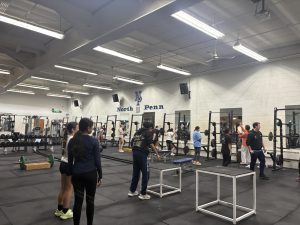
“The benefit is that the district and the school allows us to [practice indoors] because if not, we’re out of space; especially with snow on the track and how cold it is sometimes,” Richhart stated. “We are fortunate enough that we do have a building that allows us to workout inside. There are definitely a lot of things that go into making sure we’re safe and that staff and custodians can still do their job.”
Despite the hurdles to overcome, like the careful avoidance of injury and the creative workouts developed around the limitation of room, the track athletes and coaches still show up to practice, no matter the circumstances.
“You just have to do it because everybody knows you have to get better,” Richhart concluded.