

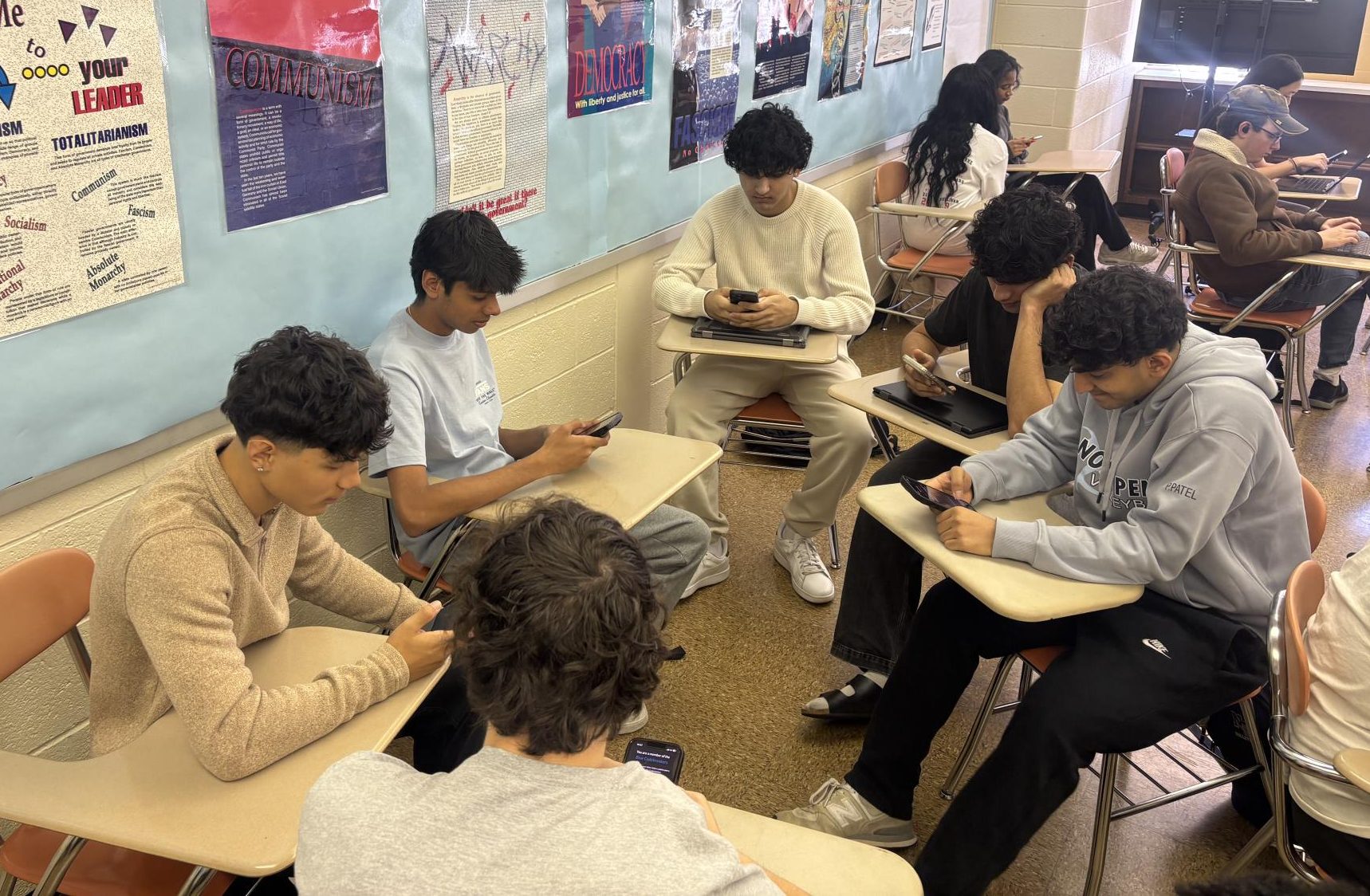
TOWAMENCIN- The advancement of Senate Bill 1014 is a push by lawmakers to remove cell phones in learning environments. The legislation aims to “establish a clear, consistent statewide standard prohibiting cellphone use during the school day, while still allowing school districts the flexibility to implement policies in a way that works best for their communities,” as a joint statement from Senators Devlin Robinson (R-37), Vincent Hughes (D-7), and Steve Santarseiro (D-10) describes.
For Pennsylvania school districts like North Penn, the bill has advanced enough now to be a part of larger discussions.
At the April 23 School Board Action Meeting, Mr. Tim MacBain, North Penn School Board member and Chair of ECI and Legislative committees, presented on the topic.
“Citing student mental health data, and alarming trends related to cell phone use by children in Pennsylvania, the Senate has taken steps to create ‘Phone Free Schools.’ Senate Bill 1014 would require districts to establish rules for students and families which would limit phone use during the school day, and refocus students during instructional time,” MacBain explained in the meeting.
“North Penn cell phone policies would not need to be significantly altered to meet the requirements of the bill as it is currently written. The bill has passed the Senate, and was most recently referred to the House Education Committee,” MacBain continued.
The mental health data referenced was linked through the board meeting agenda, including a memo from Senators Devlin Robinson, Vincent Hughes and Steven Santarsiero that explained the mental impacts of cell phone use on youth.
“Historical data shows a steep decline in mental health in children between 2010-2019 where rates of depression and anxiety rose 50%, the suicide rate for adolescents ages 10-19 rose 48%, while the suicide rate for girls ages 10-14 rose and astonishing 131%,” the memo reads.
“Just last week, a new study published in the Journal of Human Development and Capabilities found that children who receive smartphones before the age of 13 were significantly more likely to experience serious mental health problems in early adulthood including aggression, emotional instability, and suicidal thoughts. Yet the average age for a child to have a smartphone in Pennsylvania is reportedly 10.5, a number that seems to get younger every year,” the memo continued.
The memo also cited the addictive nature of cell phone usage on adolescents, noting an average daily screen time of 8 hours for teens. The memo draws the connection between increasing phone use and declining academic achievement in schools, with math and reading scores on a continuing decline since 2012.
“The correlating data between the mental health decline and academic decline of children and the rise of smartphones is clear. While the broader discussion of whether age limits should be applied to smartphones and social media, we can make an immediate impact to improve the health and academic performance of our children through distraction free learning while at school. To that end, we intend to introduce legislation to require schools to adopt and implement a policy that prohibits the use of phones during the school day,” the memo’s conclusion read.
“Exceptions would be made for students with medical conditions or individualized education plans that require the use of a personal communication device,” the memo noted.
The impact on cell phone usage is not just on students; it is also on the teachers at the front of the room.
Mr. Dwight Homan, an AP U.S. Government and Politics teacher at North Penn High School, has seen the effects of cell phone use first hand, and feels the frustration of many teachers with the overwhelming presence of phones during instructional time.
“I’ve seen a lot of distraction, a lot of lack of focus and attention. There’s an impact on concentrating on the task at hand. Studies have shown that when we limit that contact with phones, we get better scores and better comprehension. My observation is, while we have a policy that says phones aren’t out, there’s a major disconnect between having a policy and holding students accountable to that policy,” Homan said.
“It’s demoralizing. You feel like you’re up there spinning your wheels, talking to a wall. It’s been increasingly frustrating. [There is] lack of face-to-face communication, not just with students and teachers, but among peers. You observe in a classroom, students come in and before they start class, they’re not talking to one another, asking how one another is doing. They’re on their phones. I think it has truly become an addiction, starting in elementary school and up through high school,” Homan said.
Mr. Nathan Snyder, an AP Research and AP Biology teacher at North Penn, also spoke to his perception of phones in the classroom.
“I’ve been teaching for about sixteen years, and cell phones were definitely less prominent when I started teaching. Every year, they become a little bit more of an issue. My concern is that students spend a lot of time on their phones that is really unproductive time and doesn’t really serve that academic purpose at all. I do think cell phones are a distraction, and I think it’s very hard for students to resist the temptation to check the phone,” Snyder said.
“I agree with the statement that [a cell phone restriction] would affect their performance positively and their mental health positively. I don’t know that there needs to be a ban, but I think that when cell phones come into the classroom, they should be separated from the student. What that does is it takes pressure off of the teacher in terms of having to police phones, and then students have the ability then to not feel like they have to check it, because they can’t check it because it’s actually somewhere else,” Snyder said further.
Though the Pennsylvania “Phone-Free Schools” bill has not reached its final form and still requires an official passing before being set in stone, the conversation is moving forward. Regardless of whether or not the bill passes, it is clear the presence of cell phones is felt heavily throughout the school.